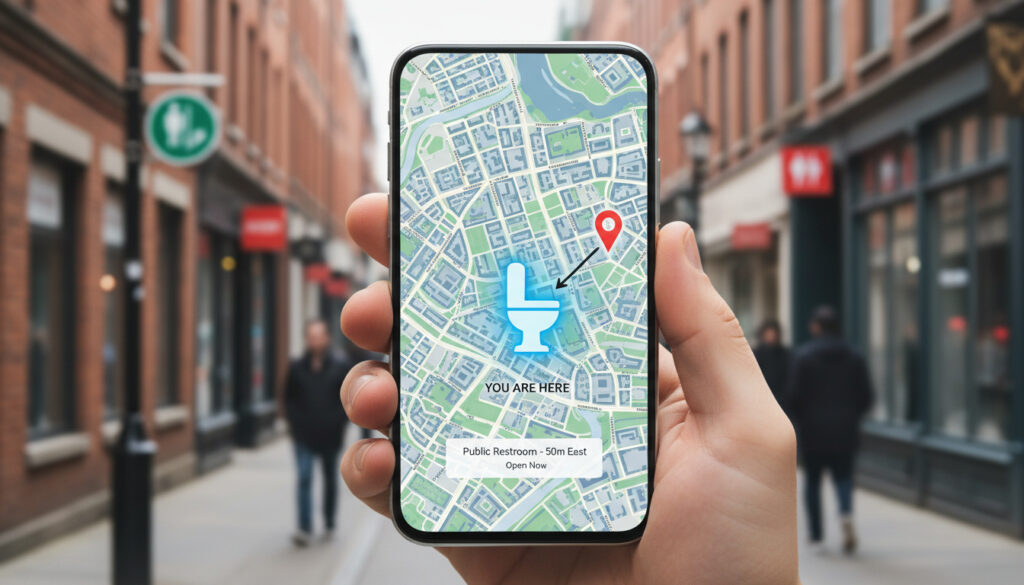
Toilet Near Me – Best Apps and Maps for Quick Access
Urgent biological needs do not wait for convenient moments. Whether navigating an unfamiliar city, managing a medical condition, or simply caught between destinations, locating a public restroom quickly has become a solvable problem through modern mobile technology.
The search for nearby facilities has shifted from frantic visual scanning of street corners to precise GPS-enabled solutions. Multiple digital tools now aggregate crowdsourced data on over 1.8 million global restroom locations, offering real-time directions, accessibility filters, and user-generated cleanliness ratings.
Understanding which tools provide the fastest, most reliable results—and their specific limitations—determines whether you find relief in minutes or waste precious time searching in the wrong direction.
How Do I Find a Toilet Near Me?
Four primary methods dominate the landscape for locating public restrooms, each balancing speed against detail.
Free, instant, requires no installation
Limitation: Lacks dedicated offline toilet filters
Best for: Immediate emergency searches
Detailed accessibility filters, offline modes, ratings
Limitation: Requires download, variable crowdsourced accuracy
Best for: Frequent travelers, accessibility needs
Official municipal data, high local accuracy
Limitation: Limited coverage, often desktop-optimized
Best for: Urban residents planning routes
Predictable cleanliness, secure environments
Limitation: May require purchase, not public infrastructure
Best for: When quality and safety matter most
Key patterns emerge when evaluating these approaches:
- Mobile applications now dominate urgent search scenarios, outpacing web-based directories in speed
- Google Maps functions as the default first check for the majority of users due to universal installation
- User-generated ratings increasingly determine which facilities travelers actually trust
- Free public options remain widely available in urban centers, though rural coverage thins significantly
- Accessibility details often lack independent verification, requiring on-site confirmation
- Offline functionality proves critical in subway systems, remote highways, and international roaming scenarios
- Crowdsourced databases rely on continuous user contributions to remain current
| Fact | Detail | Source Basis |
|---|---|---|
| Maximum database size | 1.8 million+ locations (Bathroom Scout) | App store specifications |
| Primary location method | GPS triangulation with proximity sorting | Technical documentation |
| Google Maps coverage | Business listings augmented by user reports | Platform documentation |
| Offline capability | Flush and Where is Public Toilet? offer local storage | Developer feature lists |
| Accessibility filtering | Available in Flush, WC Finder with traffic-light coding | Interface analysis |
| Cost structure | Most apps free with advertisement support | App store pricing |
| Data accuracy | Variable; dependent on user reporting frequency | User review analysis |
| Update mechanism | Real-time user submissions for closures or changes | Platform operational docs |
What Apps Show Public Toilets Nearby?
Specialized applications outperform general mapping tools when specific needs arise. These platforms aggregate hundreds of thousands of facility records, offering granular filters unavailable in standard map software.
Flush Toilet Finder
Flush Toilet Finder maintains a database exceeding 200,000 restrooms globally. The interface displays the nearest options on a searchable map, with filters for disabled access, fee requirements, and whether facilities require keys for entry. Users praise its offline functionality, which stores data locally for use without cellular connectivity. However, some note that information regarding baby changing stations needs more frequent updates.
Toilet Finder and Where is Public Toilet?
Toilet Finder operates on a community-driven model, allowing users to add newly discovered facilities or report closures via a simple interface. The platform covers over 150,000 locations worldwide. For users in Australia, Where is Public Toilet? provides particular value with 280,000+ entries, Google Street View integration, and filters for unisex facilities, parking availability, and showers. Both apps support emergency situations through offline download capabilities.
Refuge Restrooms and Specialized Tools
Refuge Restrooms serves a specific demographic need, focusing on unisex and gender-neutral facilities for the LGBTQ+ community. The web-based platform provides a public API and resources like printable signs. For those prioritizing sheer volume, Bathroom Scout claims 1.8 million entries including restaurants, while specialized health resources recommend apps like WC Finder for inflammatory bowel disease management due to detailed accessibility reporting.
Wheelchair users should prioritize Flush or WC Finder, which employ traffic-light systems where green indicators confirm full wheelchair accessibility. These apps specifically filter out locations requiring stair navigation or narrow entryways, though users should verify conditions via Street View before traveling, as crowdsourced data may not reflect recent renovations.
Where Is the Nearest Public Toilet?
Proximity depends on urban density, time of day, and willingness to use alternative venues when dedicated public facilities close.
Free Public Infrastructure
Municipal parks, transit stations, and public libraries maintain the most consistently available free options. Large retail chains often accommodate urgent needs, with Shell Near Me locations and similar service stations typically providing accessible facilities regardless of purchase. These venues usually operate during standard business hours, though 24-hour gas stations offer overnight alternatives.
Evaluating Cleanliness and Safety
User ratings within apps like Flush and Bathroom Scout indicate cleanliness levels through star systems and condition reports. WC Finder incorporates actual photographs from users, providing visual verification of maintenance standards. For safety, Street View integration in Where is Public Toilet? allows visual assessment of the surrounding area before arrival.
What to Do If No Toilet Is Nearby?
Dead zones in app coverage occur in rural highways, newly developed suburbs, or during late-night hours when public facilities lock. Alternative strategies become necessary when GPS shows no results within comfortable range.
When digital maps show no public options, pharmacies such as Chemist Warehouse Maryborough typically maintain accessible restrooms for customers. Large retail chains, hotel lobbies, and fast-food restaurants generally accommodate urgent requests, though purchasing a small item represents standard etiquette. Hospitals maintain 24-hour facilities, though these should be reserved for genuine emergencies.
Download Flush or Where is Public Toilet? before entering areas with poor cellular coverage. These applications store database portions locally, allowing GPS-based searching without data or WiFi. This preparation proves essential for subway systems, remote hiking trails, and international travel outside roaming zones.
When Are Public Toilets Available?
Access varies predictably by location type and hour. Understanding these patterns prevents wasted trips to locked facilities.
- Early Morning (05:00–08:00): Transit hubs and 24-hour service stations open first, while park facilities typically remain closed until maintenance crews arrive.
- Business Hours (09:00–17:00): Shopping centers, public libraries, and municipal buildings maintain regular access with full staffing and maintenance.
- Evening Transition (18:00–22:00): Parks and public squares often lock gates, while restaurants and bars remain accessible, sometimes requiring patronage.
- Overnight (22:00–05:00): Only 24-hour convenience stores, hospitals, and select gas stations provide reliable options; plan accordingly.
What Information Can You Trust?
Not all restroom data carries equal reliability. Crowdsourced platforms depend on user participation, creating variability in accuracy.
| Established Facts | Uncertain Variables |
|---|---|
| GPS coordinates in major apps | Real-time cleanliness conditions |
| Published opening hours | Current maintenance or renovation status |
| Presence of disabled access ramps | Availability of toilet paper or hand soap |
| Fee requirements and key systems | Security of the surrounding area at night |
| Existence of baby changing stations | Queue lengths during peak tourist seasons |
Why Accurate Restroom Data Matters
Universal access to sanitation infrastructure represents more than convenience; it determines participation in public life for individuals with chronic conditions, elderly populations, and families with young children. The National Association for Continence identifies restroom anxiety as a significant barrier to travel and social engagement, making reliable location data a matter of health equity.
The shift toward mobile-first location services reflects broader urban planning trends. As cities reduce public facility maintenance costs, privately maintained options in commercial spaces increasingly fill gaps. Digital directories bridge this transition, directing users to verified locations while municipal databases update slowly.
What Do Users and Developers Say?
Users praise accessibility information but consistently request more frequent updates for features like baby changing stations and real-time closure notifications.
— Analysis of App Store reviews for Flush Toilet Finder
For individuals managing inflammatory bowel disease, detailed filters separating ‘wheelchair accessible’ from ‘fully ADA compliant’ determine whether a facility actually meets medical needs during emergencies.
What Should You Do Right Now?
Enable location services, search “toilet near me” in your preferred mapping application, and verify recent user ratings before departing. For predictable daily routes, download an offline-capable app such as Flush to ensure coverage during transit dead zones.
Common Questions
Do these apps work without internet?
Flush and Where is Public Toilet? offer offline modes that store database sections locally. Google Maps requires data for real-time searches, though saved maps help minimally.
Are the toilets actually free?
Most entries in Flush and Toilet Finder include fee filters. While many public facilities remain free, some European cities and private venues charge small fees.
How accurate are the accessibility ratings?
Ratings rely on user reports, not professional audits. Verify via recent photos or Street View, as renovations or temporary closures may not update immediately.
Can I add a toilet I found?
Toilet Finder, Refuge Restrooms, and MapComplete allow user submissions. Contributions require GPS coordinates and basic facility details.
What if the app shows a toilet but it’s locked?
Report closures immediately within the app interface. Many facilities require keys available at nearby cafes or shops, indicated in app descriptions when known.
More related posts
 Aisha Tyler: Biography, Personal Life, LGBTQ Role, and More
 Code of Conduct: Definition, Principles, and Examples
 Signs of ADHD: Key Symptoms in Adults, Children, Teens
 Christopher Meloni: Career, Family, and Why He Left SVU
 Byeon Woo-Seok: Height, Wife, Drama List & Facts
 Hermione Corfield: Biography, Star Wars, and Upcoming Projects
 Nick Nolte: Oscar-Nominated Career, DUI Arrest & Health