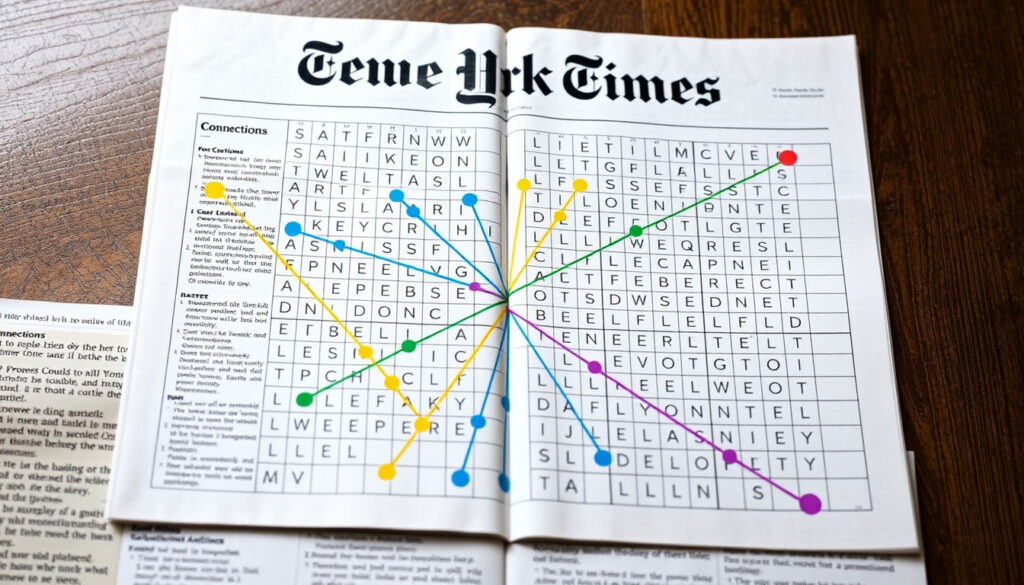
Connections New York Times – Complete Guide to Rules and Strategies
Connections New York Times is a free daily word puzzle that challenges players to group 16 words into four themed categories. Since its launch in 2023, the game has become one of the most popular features in the NYT Games lineup, attracting millions of players who enjoy its unique categorization mechanic. Unlike traditional word games that focus on spelling or guessing, Connections requires lateral thinking and pattern recognition.
The puzzle presents players with a grid of seemingly unrelated words, asking them to discover hidden connections. Each day brings a fresh challenge, with difficulty escalating across four color-coded levels. Players have four attempts to find all four groups before the puzzle is lost, making every guess count.
This guide covers everything from basic rules to advanced strategies, helping both newcomers and seasoned players improve their solving skills. Whether you’re looking to understand how the game works or seeking tips to improve your win rate, this comprehensive overview provides the answers you need.
What is Connections New York Times?
Connections New York Times is a daily puzzle game developed by The New York Times as part of their expanded Games subscription service. The concept is straightforward yet addictive: players receive 16 words arranged in a 4×4 grid and must identify four hidden categories, each containing four related words. The categories can range from obvious groupings like “fruits” or “colors” to clever wordplay involving homophones, puns, or cultural references.
The game launched in 2023, emerging from The New York Times’ successful expansion into digital puzzle gaming following their acquisition of Wordle. According to available sources, the game quickly gained popularity for its distinctive grouping mechanic, which differs significantly from the linear guessing approach used in Wordle. Players access the puzzle through the NYT Games platform, either via web browser or mobile application.
2023
16 words into 4 themes
Yellow (easy) to Purple (hard)
NYT Games app/web
Key Facts About Connections NYT
- Each puzzle contains exactly 16 words that must be divided into 4 groups of 4
- Categories are specific rather than vague (e.g., “Chef’s toolkit” not “kitchen items”)
- The game offers unlimited daily puzzles with one new challenge released every 24 hours
- Players receive feedback through grayed-out invalid combinations
- Near-correct guesses (3 out of 4 words right) reveal which word belongs elsewhere
- The game emphasizes vocabulary building derived from NYT content
- No numerical scoring exists; success is binary (complete win or loss)
| Feature | Details |
|---|---|
| Developer | The New York Times |
| Initial Release | 2023 |
| Daily Puzzles | One new puzzle every 24 hours |
| Attempts Allowed | Four incorrect guesses |
| Cost | Free with NYT Games access |
| Platform Access | Web browser, iOS, Android |
How Do You Play Connections NYT?
Playing Connections New York Times requires selecting four words from the 16-word grid that share a common theme. Players tap or click to select words, then submit their grouping to check if it is correct. If the selection matches a hidden category, those four words disappear from the grid, revealing part of the solution. If the guess is incorrect, one of four allowed mistakes is recorded, and the invalid combination grays out to prevent repeated attempts.
The game continues until players discover all four categories or exhaust their four mistakes. Each successful group is revealed with its theme name, such as “Chef’s toolkit” or “Go big or go home” idioms. The difficulty lies in identifying connections that are specific enough to form legitimate categories without being too broad or vague.
Difficulty Levels in Connections
Groups in Connections New York Times are revealed in order of difficulty, marked by color coding that helps players understand the challenge ahead:
- Yellow: The easiest and most obvious connections, typically involving common categories like colors, fruits, or everyday objects that most players identify immediately
- Green: Moderate difficulty requiring some lateral thinking or slightly less common associations
- Blue: Harder groupings that often involve wordplay, puns, or less obvious connections
- Purple: The most challenging category, frequently featuring clever wordplay, obscure references, or clever misdirections such as “many arms/no arms” connections (e.g., octopus versus Venus de Milo)
The color progression from yellow to purple reflects increasing difficulty. Experienced players often save purple-category words for last, using the easier groups to narrow down possibilities through elimination.
Scoring and Win Conditions
Connections New York Times uses a binary scoring system. Players either complete all four groups within four mistakes (a win) or fail to solve the puzzle (a loss). There is no numerical score, timer pressure, or partial credit system. According to player discussions, this straightforward approach focuses attention on the puzzle-solving experience rather than performance metrics.
The feedback mechanism helps players learn from mistakes. When a guess contains three correct words and one incorrect word, the game typically indicates which word belongs to a different group, effectively providing a hint through the near-miss system. This feature encourages strategic thinking about which words might fit multiple categories.
Where to Play and Is It Free?
The puzzle is accessible through multiple platforms. Players can access Connections via the official NYT Games website or download the NYT Games app for iOS and Android devices. The game is free to play, though some features may require an NYT Games subscription for full access across all platforms.
The NYT Games mobile application provides a streamlined experience optimized for touchscreens, making it easy to select and submit word combinations on the go. The web version offers identical functionality through any modern browser.
For the best experience, consider using the dedicated NYT Games app rather than the web version. The mobile app offers smoother interactions for selecting words and provides notifications for daily puzzle availability.
What Are Today’s Connections Answers and Hints?
Since Connections New York Times releases a new puzzle daily, specific answers vary each day. Players seeking hints or theme previews can use third-party resources like connectionshint.online, which provides daily theme overviews, word definitions, and partial reveals without spoiling the complete solution.
These external hint sites aggregate community discussions and can help players stuck on particular puzzles. However, using such resources is entirely optional, and many players prefer the satisfaction of solving puzzles independently. The puzzle refreshes at midnight Eastern Time, giving players in different time zones varying windows of opportunity to access the daily challenge.
Connections Archive: Accessing Past Puzzles
Currently, no official free archive exists for Connections New York Times. Unlike Wordle, which allows players to revisit previous puzzles through the website, Connections puzzles remain accessible only on the day they are released. Players who miss a puzzle cannot go back and solve it officially.
Third-party websites and community forums occasionally discuss past puzzle themes, offering indirect access to previous challenges. However, these sources do not provide the official puzzle interface and should be used with awareness that they represent community interpretation rather than official archives.
Unlike some other NYT games, Connections does not offer an official archive feature. Missing a daily puzzle means it cannot be played retroactively through official channels.
How to Solve Connections NYT Puzzles: Strategies and Tips
Successfully solving Connections puzzles requires a combination of pattern recognition, elimination strategy, and awareness of common puzzle-making techniques. Players who consistently win typically develop systematic approaches that balance speed with accuracy.
Essential Strategies for Beginners
Starting with obvious themes provides a foundation for solving harder groups. Look for concrete categories like colors, fruits, animals, or professions that appear frequently in puzzles. Grouping known pairs first and building outward helps narrow down possibilities systematically. Writing down potential pairs on paper can reveal “cliques” of strong connections that might otherwise be overlooked.
Analyzing mistakes proves particularly valuable in Connections. When a guess includes three correct words, the game effectively points out which word belongs elsewhere, offering crucial information for solving other groups. Players should pay close attention to these near-misses rather than dismissing them as failed attempts.
Avoiding Common Mistakes
- Overthinking obvious groups: Many players waste attempts chasing obscure references when simpler solutions exist
- Ignoring near-miss feedback: Three-correct guesses reveal the outlier word for another category
- Falling for trap words: Words like “ring” that could fit weddings or sounds create intentional traps
- Rushing without pairing: Submitting guesses without first identifying strong word pairs leads to quick lockouts
- Chasing similar-sounding decoys: Homophones and sound-alikes are common puzzle devices
When stuck, rotate borderline words last rather than first. Testing the most confident pairs first preserves limited attempts for situations where elimination narrows choices to a few viable options.
Connections vs Wordle: Key Differences
Understanding how Connections differs from Wordle helps players adapt their approach. Wordle presents a single target word with letter-based feedback through colored tiles, allowing six attempts in a linear spelling challenge. Connections, by contrast, requires categorizing multiple words simultaneously, with feedback limited to whether groups are correct or incorrect.
The strategic frameworks differ significantly. Wordle rewards systematic letter elimination, while Connections demands associative thinking and recognition of thematic patterns. Players transitioning from Wordle often find Connections more time-consuming due to the need to consider multiple potential groupings simultaneously.
Both games share the daily ritual element and free-to-play model, but their core mechanics create distinct puzzle-solving experiences. Some players enjoy alternating between both games to exercise different cognitive skills.
The Evolution of Connections: A Timeline
Connections New York Times represents The New York Times’ strategic expansion into digital puzzle gaming following their acquisition of Wordle. The game’s development reflects the publication’s efforts to engage younger audiences and expand beyond traditional news content.
- 2023 Launch: Connections debuted as part of the NYT Games lineup, positioning itself alongside Wordle as a daily brain teaser option
- Post-Wordle Integration: Following the success of their Wordle acquisition, NYT expanded puzzle offerings to include Connections
- Mobile App Integration: The game became available through the dedicated NYT Games mobile application, improving accessibility
- Continued Updates: The platform continues receiving updates and improvements based on player feedback
What Is Verified vs. Uncertain About Connections
| Established Information | Information Requiring Verification |
|---|---|
| Launch date: 2023 | Specific player statistics and engagement metrics |
| Four color-coded difficulty levels | Exact subscription requirements for full features |
| Four attempts per puzzle | Future feature roadmap and planned updates |
| Free daily access via NYT Games | Specific algorithm for difficulty progression |
| No official archive exists | Community statistics on win rates |
The Role of Connections in the NYT Games Ecosystem
Connections New York Times occupies a unique position within the broader NYT Games portfolio. The puzzle leverages The New York Times’ expertise in wordplay and language while introducing mechanics that appeal to players who enjoy categorization and pattern recognition. The game’s integration alongside Wordle, Spelling Bee, and crossword puzzles creates a comprehensive daily gaming experience.
The categorization mechanic differentiates Connections from other NYT word games, attracting players who prefer associative thinking over spelling challenges. This variety helps the platform serve diverse audience preferences, from casual players seeking quick daily entertainment to serious puzzle enthusiasts looking for deeper engagement.
For those interested in expanding their puzzle skills, the game pairs well with other word-based challenges. Air Fryer Salmon – Exact Time and Temperature Guide offers a practical break from mental exercises, while exploring the relationship between different puzzle types can enhance overall cognitive flexibility.
Community Resources and Official Sources
Player communities have developed around Connections, sharing strategies, discussing difficulty levels, and helping each other through challenging puzzles. These discussions provide valuable insights into common solving approaches and typical puzzle patterns.
Official information comes primarily from The New York Times Games team. Players seeking authoritative guidance should consult the official Connections page for rules explanations and platform announcements.
The game quickly gained popularity for its addictive grouping mechanic, positioning it as a staple of the NYT Games daily lineup alongside Wordle.
— Based on published game documentation
Summary: Key Takeaways About Connections NYT
Connections New York Times offers a unique daily puzzle experience that challenges players to find hidden categories among 16 words. The game rewards pattern recognition, systematic elimination, and creative thinking while maintaining accessibility through free daily access. With four difficulty levels ranging from yellow to purple, players can enjoy both quick wins and challenging solves within the same format.
Success in Connections depends on recognizing common puzzle patterns, learning from near-miss feedback, and avoiding the trap of overthinking obvious groupings. The game provides a satisfying alternative to Wordle’s spelling challenges, appealing to players who enjoy categorization and associative thinking. For those seeking to expand their puzzle repertoire, Tuna Pasta Bake – Quick Healthy Family Dinner Recipe demonstrates how diverse interests can complement daily puzzle routines.
Frequently Asked Questions
Is Connections free to play?
Yes, Connections New York Times is free to access through the NYT Games app or website. Basic daily puzzles are available without a subscription.
Can I access past Connections puzzles?
No official archive exists for Connections puzzles. Each puzzle is available only on the day it is released, and missed puzzles cannot be played retroactively.
What are the most common mistakes in Connections?
Common mistakes include overthinking obvious groups, ignoring feedback from near-correct guesses, falling for trap words that fit multiple categories, and rushing without first identifying strong word pairs.
How is Connections different from Wordle?
Wordle uses letter-based feedback for single-word guessing, while Connections requires categorizing 16 words into themed groups with limited attempts. The games exercise different cognitive skills.
What do the colors in Connections mean?
Colors indicate difficulty progression. Yellow represents the easiest category, followed by green (moderate), blue (harder), and purple (most challenging with wordplay or obscure references).
Where can I find hints for daily Connections puzzles?
Third-party sites like connectionshint.online offer daily theme previews and partial hints. The official NYT Games platform provides the puzzle itself without built-in hints.
More related posts
 Effect or Affect: How to Pick the Right One Every Time
 Aud to Philippine Peso – Current Rate Chart History
 Cast of Riverdale: Full Actors & Characters List (Seasons 1-7)
 William McInnes: Biography, Partner, TV Shows, and Books
 Sophia Katseye: Biography, Facts, and Role in KATSEYE
 ANZ Internet Banking Login: Secure NZ Access Guide
 She’s the Man Streaming Guide – Where to Watch in UK