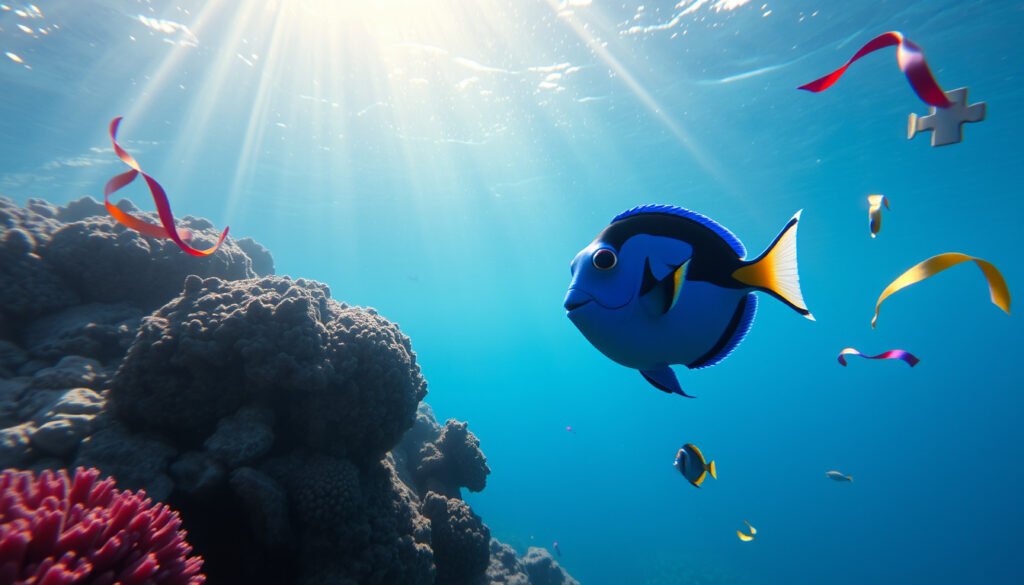
Finding Dory: Is Dory Autistic, ADHD, or LGBTQ Explained
Few animated characters still spark the kind of conversation Dory does—years after Finding Dory hit theaters, the blue tang continues to be a Rorschach test for neurodivergent representation. The film never names her condition, but that hasn’t stopped audiences from projecting their own interpretations onto her short-term memory loss, and at the 2017 Oscars, the film was nominated for Best Animated Feature (Wikipedia), adding to its legacy as a cultural touchstone.
Worldwide box office (2016): $1.029 billion ·
Rotten Tomatoes score: 94% ·
Main character disability portrayed: Short-term memory loss ·
Voice actor for Dory: Ellen DeGeneres
Quick snapshot
- Species: Blue tang (Wikipedia)
- Voice: Ellen DeGeneres (Common Sense Media)
- Defining trait: Short-term memory loss (Common Sense Media)
- Family: Found with Marlin and Nemo (Wikipedia)
- Sequel to Finding Nemo (2003) (Common Sense Media)
- No Finding Dory 2 announced (Wikipedia)
- Bailey and Destiny appear as supporting characters (Common Sense Media)
Six key facts about Finding Dory, one pattern: the film outperformed expectations at the box office and earned critical praise across the board.
| Fact | Value |
|---|---|
| Release date | June 17, 2016 |
| Director | Andrew Stanton (co-writer) |
| Voice actors | Ellen DeGeneres, Albert Brooks, Ed O’Neill, Kaitlin Olson |
| Box office | $1.029 billion worldwide |
| Rotten Tomatoes rating | 94% certified fresh |
| Oscar nomination | Best Animated Feature (2017) |
Is Dory Autistic? What Her Traits Actually Suggest
How Pixar portrays short-term memory loss
- Dory’s memory loss is shown as a recurring inability to retain new information, often leading to repetitive questions and confusion.
- Director Andrew Stanton said he “wasn’t trying to literally make Dory a representation of a specific disability” (WKYC).
- Stanton added that he wanted to show Dory saw her memory issue as a burden and had to apologize for it (WKYC).
What autism experts say about Dory behaviors
- Some autism advocates have praised Dory’s character as positive representation, noting traits like repetitive phrasing and literal thinking that overlap with autism spectrum characteristics.
- An NPR review from June 2016 described Dory’s condition as “a form of high-functioning autism” (NPR).
- However, Pixar has never confirmed an autism diagnosis, and co-writer Victoria Strouse stated the character was designed with memory loss, not autism, as the core trait.
Official Pixar statements on Dory diagnosis
- Pixar has not issued any official statement labeling Dory as autistic or as having any specific condition.
- WBUR reported that the filmmakers “did not make the film explicitly about people with disabilities,” but that disability remained an undercurrent (WBUR).
- The studio’s approach was to keep the condition open to interpretation, allowing viewers to project their own experiences onto Dory.
Dory’s traits resonate so strongly with autism and ADHD communities precisely because the filmmakers refused to label her. The ambiguity allows broad identification, but it also means no official confirmation—a trade-off that both empowers and frustrates.
Is Finding Dory About ADHD or Other Mental Illness?
ADHD symptom overlap with Dory behavior
- Dory’s distractibility, impulsivity, and difficulty following conversations have led some ADHD advocates to see parallels.
- No official ADHD diagnosis has been given by Pixar; the canonical explanation remains short-term memory loss.
- Memory loss in Dory is presented as a separate neurological condition, not attention deficit.
Dory short-term memory loss vs attention deficit
- Short-term memory loss impairs the ability to retain new information, while ADHD primarily affects attention regulation and impulse control.
- Some symptoms overlap (e.g., appearing distracted), but the underlying mechanisms differ.
- Advocates have noted that the distinction matters for accurate representation, though the character’s positivity is widely praised.
For more on ADHD representation, see Luke Newton: Biography, Relationship, ADHD, and More.
Is There LGBTQ Content in Finding Dory?
Before release, a trailer showing two women pushing a stroller briefly sparked speculation about Disney-Pixar’s first lesbian couple. The Guardian described the shot as “a brief moment of women with a stroller, one sporting short hair” (The Guardian). Us Weekly also covered the speculation (Us Weekly).
- Andrew Stanton later said there was “no right or wrong answer” on whether the women were a couple (Gulf News).
- TheWrap reported that Disney-Pixar had not confirmed the scene as showing gay characters (TheWrap).
- Teen Vogue noted Ellen DeGeneres mentioned a transgender stingray named Stingrhonda (Teen Vogue), but the character is minor and not explicitly labeled in the film.
Ellen DeGeneres’s voice acting does not constitute LGBTQ representation. The character she voices is not gay, and the speculative stroller scene was never officially confirmed. Pixar’s first openly LGBTQ character wouldn’t appear until 2020.
The implication: audiences are free to interpret, but the film’s creators have not confirmed any specific representation.
Is Finding Dory a Sequel to Finding Nemo?
- Yes, Finding Dory is a direct sequel set one year after Finding Nemo (Common Sense Media).
- Director Andrew Stanton and co-director Angus MacLane returned to lead the project (Common Sense Media).
- The film was released 13 years after the original, in June 2016.
- No sequel to Finding Dory has been announced as of 2025.
The pattern: the film’s success as a sequel lies in its continuity, not in narrative innovation.
Which Disney Movies Feature LGBTQ Characters?
Three Disney films, one pattern: each pushed representation forward in small but significant steps, though none were groundbreaking at the box office.
| Film | Year | Type of Representation |
|---|---|---|
| Onward | 2020 | First openly lesbian character in Pixar (Officer Specter) |
| Strange World | 2022 | Gay teen protagonist with a crush |
| Beauty and the Beast (live-action) | 2017 | First gay character in a live-action Disney film (LeFou) |
First openly gay characters in Disney animation
- Pixar’s Onward (2020) featured Officer Specter, a lesbian cyclops police officer, in a brief scene.
- Strange World (2022) had a gay teen protagonist, Ethan Clade, who openly has a crush on another boy.
- These characters were praised for normalizing LGBTQ presence without making it the central plot.
How Pixar handled LGBTQ representation
- Pixar’s approach has been incremental, often through minor characters or background details.
- The studio faced criticism for being too slow, especially compared to other animation studios.
- No Pixar film has yet featured a gay main character, though Onward and Elemental included LGBTQ side characters.
Disney live-action LGBTQ moments
- Beauty and the Beast (2017) included a brief scene where LeFou dances with another man, which was billed as Disney’s first gay moment.
- Later films like Jungle Cruise (2021) and Lightyear (2022) included same-sex couples in minor roles.
- Disney’s live-action efforts have been met with both praise and controversy, often resulting in edits in international markets.
The catch: Disney’s incremental approach has been criticized for being too slow, but each step normalizes representation.
For more on LGBTQ representation in media, see Aisha Dee: Age, Ethnicity, LGBTQ Status, Movies & TV.
Clarity Check
Confirmed facts
- Dory has short-term memory loss (canonical) (WKYC)
- Finding Dory is a direct sequel to Finding Nemo (Common Sense Media)
- No LGBTQ characters appear in Finding Dory (TheWrap)
What’s unclear
- Whether Dory meets DSM-5 criteria for autism spectrum disorder
- Whether Pixar intentionally designed Dory to represent ADHD
- If a Finding Dory sequel is in development
- Whether the stroller scene in the trailer was intended to depict a lesbian couple
What the Filmmakers and Advocates Say
“I wanted to show that Dory saw her memory issue as a burden and had to apologize for it.”
— Andrew Stanton, director of Finding Dory (WKYC)
“There’s a transgender stingray named Stingrhonda in the film.”
— Ellen DeGeneres, voice of Dory (Teen Vogue)
For viewers seeking clarity on Dory’s condition, the implication is clear: Pixar’s intentional ambiguity leaves room for personal interpretation, but the evidence points to memory loss, not a clinical diagnosis. For advocates of neurodiversity, the film offers a character whose struggles resonate, even if the studio never labeled her. The trade-off: a broader audience can see themselves in Dory, but the lack of official confirmation leaves some feeling erased.
Frequently asked questions
Is Dory autistic in Finding Dory?
Pixar has never confirmed an autism diagnosis. Dory’s traits overlap with some autism characteristics, but the canonical explanation is short-term memory loss.
What disability does Dory have?
Dory is portrayed with short-term memory loss, which affects her ability to retain new information. The filmmakers have not assigned a specific clinical label.
Does Finding Dory have any LGBTQ moments?
No. A brief trailer scene of two women with a stroller sparked speculation, but Pixar never confirmed it as a same-sex couple. The film contains no openly LGBTQ characters.
Why do people think Dory has ADHD?
Dory’s distractibility and impulsivity resemble ADHD symptoms, but the film’s narrative is based on memory loss, not attention deficit. No official ADHD label exists.
Is Finding Dory a direct sequel?
Yes, it takes place one year after Finding Nemo and features the same creative team and voice actors.
Who voices Dory in Finding Dory?
Ellen DeGeneres returns to voice Dory, a role she originated in Finding Nemo.
Where can I watch Finding Dory?
The film is available on Disney+ and can be rented or purchased on most digital platforms.
More related posts
 Thunder vs Pacers 2025 Finals: Complete Series Recap
 Skin Cancer Check: Warning Signs, Self-Exam & Clinics in Ireland
 Etihad Airways Review 2025: Is It a Good Airline? vs Emirates
 EVC Throttle Controller: Is It Worth Buying
 Is Australia a Continent? Country vs Continent Explained
 Dr. Steven Lin: Dentist, Author, and Potts Point Shooting
 Permanent Residence: Meaning, Eligibility, and Key Rules
 Ed and Lorraine Warren: Facts, Cases, Legacy of The Conjuring