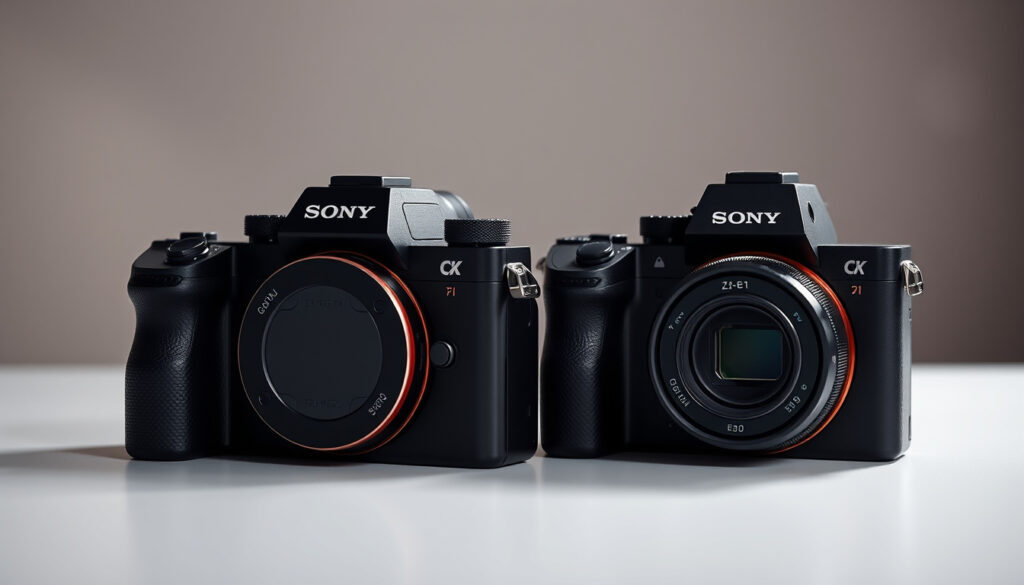
Sony ZV-E1 vs ZV-E10: Full-Frame Worth It?
If you’ve been watching YouTube reviews wondering whether to upgrade from an APS-C mirrorless to full-frame, you’re probably eyeing the Sony ZV-E1. Sony made a calculated bet here: put FX3-level imaging inside a vlogger’s body and charge roughly a third of the price. Released in May 2023, the ZV-E1 carries a full-frame 12.1MP sensor and AI autofocus that tracks human poses — but at $2,200, it’s a serious investment. This guide cuts through the specs to show how it actually performs against the ZV-E10 and where it falls short.
Sensor Type: Full-frame · Max Video Resolution: 4K 60p · Autofocus: AI-based with multiple object recognition · Key Feature: Smallest and lightest full-frame camera · Dynamic Range: High with S-Log3 support
Quick snapshot
- Full-frame 12.1MP sensor vs ZV-E10’s APS-C 24.2MP (Mirrorless Comparison spec analysis)
- 759 phase detection AF points vs 425 on ZV-E10 (Mirrorless Comparison spec analysis)
- 5-axis in-body stabilization (5 stops) vs no IBIS on ZV-E10 (Mirrorless Comparison spec analysis)
- Whether overheating in extended 4K recording is a widespread issue or isolated to certain firmware versions
- Exact current retail pricing in Ireland after recent mirrorless price jumps
- Battery life under real-world vlogging conditions — specs sheet figures rarely match field use
- ZV-E10 launched July 2021, ZV-E1 followed in May 2023 (Les Deux Pieds Dehors camera timeline)
- Sony’s ZV lineup refreshed since — ZV-E10 II is now available (Les Deux Pieds Dehors camera timeline)
- ZV-E1 has not received a successor as of early 2025 (Les Deux Pieds Dehors camera timeline)
- FV-E1 remains Sony’s premium ZV option — no successor announced as of 2025
- Full-frame lens costs may push total system price well beyond body-only MSRP
- ZV-E10 II creates a wider gap between budget and full-frame ZV options
The specifications below summarize the key technical differences between these two cameras based on comparative testing data.
| Specification | Sony ZV-E1 | Sony ZV-E10 |
|---|---|---|
| Sensor Type | Full-frame (12.1 MP) | APS-C (24.2 MP) |
| Processor | BIONZ XR | BIONZ X |
| AF Points | 759 phase detection | 425 phase detection |
| ISO Range (normal) | 80–102,400 | 100–32,000 |
| In-Body Stabilization | 5-axis, 5 stops | None (electronic only) |
| Continuous Shooting | 10 fps | 11 fps |
| Video Recording | 4K 60p, 10-bit 4:2:2 | 4K 30p, 8-bit 4:2:0 |
| Body Weight | 483 g | 343 g |
| Microphone | 3-capsule with windscreen | 3-capsule with windscreen |
| Recommended Price (launch) | $2,200 / €2,700 | $700 / €630 |
Is the Sony ZV-E1 worth it?
The ZV-E1 sits in a curious position: it’s Sony’s most capable ZV camera, yet its value depends almost entirely on what you’re shooting. For vloggers who need shallow depth of field, better low-light performance, and 10-bit footage for color grading, the premium over the ZV-E10 makes sense. For casual creators recording 1080p content, the ZV-E1’s full-frame sensor is overkill that costs three times as much.
Full-frame sensors deliver better bokeh and dynamic range, but they also demand more expensive lenses. A $2,200 body paired with a budget APS-C lens wastes the ZV-E1’s advantage — and FE-mount full-frame glass can easily double your total spend.
Pros for vloggers and creators
The ZV-E1’s full-frame sensor genuinely changes what you can capture indoors or at dusk. According to Mirrorless Comparison’s ISO analysis, the ZV-E1’s ISO range extends to 409,600 in expanded mode, compared to 51,200 for the ZV-E10 — a meaningful difference for anyone shooting without supplemental lighting.
The AI processing unit deserves particular attention. Unlike the ZV-E10, which detects eyes, faces, and animals, the ZV-E1 recognizes human poses and tracks multiple subjects simultaneously. Sony’s official Alpha Universe ZV buyers guide describes it as the top-of-the-line in the ZV lineup, with autofocus performance closer to cinema cameras than entry-level mirrorless models.
Video capabilities separate these cameras decisively. The ZV-E1 records 10-bit 4:2:2 footage at up to 4K 60p, with 4K 120fps available via firmware update — a feature Wimarys’ creator-focused comparison identifies as essential for slow-motion work that the ZV-E10 simply cannot match at 8-bit 4:2:0.
The 5-axis in-body stabilization (5 stops) versus the ZV-E10’s electronic Active mode with its 1.1× crop also matters for handheld shooting. Mirrorless Comparison’s stabilization benchmark confirms the ZV-E1’s Dynamic Active mode crops further but delivers smoother results without sacrificing as much resolution as the ZV-E10.
Cons and limitations
The ZV-E1’s weight (483 g vs 343 g for the ZV-E10) and dimensions make it noticeably larger — 6mm wider, 8mm taller, and 9mm thicker according to Camera Decision’s physical dimensions comparison. For travel vloggers counting grams, this gap matters.
At $2,200 (approximately €2,700 in EU markets), the ZV-E1 costs over three times the ZV-E10’s launch price. RTINGS.com’s value analysis identifies price as the primary weakness: the ZV-E1 is “overkill for basic vlogging” where the ZV-E10 delivers professional-looking results at a fraction of the cost.
Neither camera includes a viewfinder — a trade-off both share for the fully articulated screen vloggers need. RTINGS.com’s design philosophy analysis notes this is intentional in the ZV design philosophy, but photographers transitioning from traditional mirrorless cameras may find it limiting.
The catch: full-frame glass costs more, weighs more, and limits your lens options to FE-mount glass that’s typically larger and pricier than E-mount APS-C lenses. Buyers on a budget often end up spending more on the system than the body alone would suggest.
Sony ZV-E10 vs ZV-E1: Which Camera Is Better?
These two cameras share the same ZV design language but serve fundamentally different creators. Mirrorless Comparison’s product breakdown puts it plainly: “Their names are similar, they look the same and they have been designed for content creators, but otherwise the ZV-E1 and ZV-E10 are in two very different leagues.”
Sensor and image quality differences
The sensor gap is the defining difference. Full-frame captures roughly twice the light-gathering area of APS-C, which translates to cleaner images at high ISO, shallower depth of field for that cinematic bokeh, and better dynamic range for recovering shadow or highlight detail.
Counterintuitively, the ZV-E10’s 24.2MP resolution exceeds the ZV-E1’s 12.1MP — a tradeoff for larger photodiodes on the full-frame sensor. Wimarys’ image quality comparison notes that both megapixel counts are sufficient for 4K video, but the ZV-E1’s larger pixels deliver superior low-light performance that the resolution advantage cannot match.
Low-light AF sensitivity tells the story: the ZV-E1 focuses in conditions as dark as -6EV versus -3EV for the ZV-E10, according to Mirrorless Comparison’s autofocus sensitivity data. That -6EV rating (approximately the light from a quarter moon) means the ZV-E1 can lock focus in scenes where the ZV-E10 would hunt.
Video capabilities
10-bit versus 8-bit recording is where serious creators notice the difference most. 10-bit 4:2:2 captures 64× more color information than 8-bit 4:2:0, enabling substantial color grading without banding artifacts. Wimarys’ video spec analysis identifies this as the ZV-E1’s primary advantage for filmmakers who shoot and grade.
The ZV-E1’s BIONZ XR processor (shared with Sony’s Alpha 7S III and FX3) handles video data faster, enabling 4K 120fps slow-motion that the ZV-E10’s BIONZ X cannot achieve. Les Deux Pieds Dehors’ processor comparison documents this processing difference alongside the AI autofocus advantage.
Audio also differs: the ZV-E1’s multi-interface shoe supports digital audio via compatible microphones, while the ZV-E10 uses an analog hot shoe. Wimarys’ audio interface review notes this matters for podcast-style content where audio quality rivals video quality.
Size and portability
The ZV-E10 is genuinely pocketable at 343g. Versus.com’s weight comparison confirms the weight difference (140g heavier for the ZV-E1), which sounds modest but feels significant during a full day of handheld shooting or when packed in a small camera bag.
Travel vloggers face a compounding problem: full-frame lenses are physically larger and heavier than APS-C equivalents. A single compact FE 28mm prime weighs more than the entire ZV-E10 body. The system weight penalty extends well beyond the camera itself.
Buyers should account for lens costs when comparing body prices — the FE mount system often costs more than the camera body itself.
What are the ZV-E1’s weaknesses?
No camera is perfect, and the ZV-E1’s compromises reflect its target audience: vloggers who prioritize video quality over photography versatility. Several limitations deserve scrutiny before purchase.
The ZV-E1’s buffer handles 1,000+ JPG frames before slowdown versus the ZV-E10’s 99-frame limit — but burst shooting isn’t the ZV lineup’s strength. Neither camera replaces a dedicated sports or action body for photographers.
Ergonomics issues
The ZV-E1’s larger body (relative to other Sony mirrorless cameras) houses the same control layout as the ZV-E10, which feels underutilized on the larger chassis. Photographers accustomed to twin dials and custom buttons on Alpha-series cameras may find the streamlined ZV interface limiting for manual shooting.
The absence of a viewfinder affects usability in bright sunlight where LCD screens become difficult to read. RTINGS.com’s usability assessment notes that both cameras share this limitation, but it stings more at the ZV-E1’s price point where photographers might expect a hybrid tool rather than a pure video camera.
Battery life
Sony rates the ZV-E1 at approximately 570 shots per charge (CIPA standard) or 95 minutes of actual video recording — figures that drop significantly with Wi-Fi enabled, 4K recording, or cold weather. Les Deux Pieds Dehors’ battery specs documents this in the spec comparison, but real-world battery life varies enough that a spare NP-FW50 battery ($50-60) should be considered mandatory kit for any full-day shoot.
Other limitations
Potential overheating during extended 4K recording remains a reported concern for the ZV-E1, though firmware updates have reportedly improved thermal management. RTINGS.com’s thermal testing notes identifies this alongside the higher price as a key weakness worth monitoring before purchase.
The 12.1MP resolution, while sufficient for 4K video, limits creative cropping for still photography. Landscape and wedding photographers who need high-resolution files for large prints will find the ZV-E1’s resolution limiting compared to the ZV-E10’s 24.2MP — ironic given the full-frame sensor’s physical advantages elsewhere.
The ZV-E1 uses the FE (full-frame) mount, restricting lens options to full-frame glass. While all E-mount lenses physically fit, APS-C lenses crop to a smaller image circle on the full-frame sensor, wasting the larger sensor’s advantage and potentially introducing vignetting.
Did the Sony ZV-E1 price go up?
The ZV-E1 launched at $2,200 (approximately £2,350 / €2,700), but mirrorless camera pricing has proven volatile since 2023. Supply constraints, currency fluctuations, and industry-wide price adjustments have shifted retail prices across Sony’s entire Alpha and ZV lineup.
Specific Ireland retail pricing remains unclear in publicly available sources — EU prices listed at €2,700 for the ZV-E1 and €630 for the ZV-E10 serve as approximations. Irish buyers should verify current prices with local retailers to account for VAT and import variations.
Current pricing in Ireland
No specific Ireland pricing was found in verified sources, though Mirrorless Comparison’s European pricing indicates €2,700 as the EU launch price for the ZV-E1. Irish consumers typically pay between 20-23% VAT on electronics, which would push an equivalent €2,700 body to approximately €3,300 when retailers apply standard Irish pricing.
The ZV-E10’s €630 EU price translates to roughly €770-800 in Irish stores after VAT and retailer margins. At these price points, the value proposition shifts significantly: the ZV-E1 costs approximately 4× more than the ZV-E10 in retail terms, versus the 3× launch price ratio.
Recent US mirrorless price jumps
Sony and other manufacturers raised mirrorless camera prices throughout 2023-2024 in response to component shortages and supply chain costs. The recommended price of $2,200 may no longer reflect street pricing — current retail estimates suggest $2,400-2,600 for the body alone in US markets.
Secondary market values have held relatively stable for both cameras, suggesting that initial price increases have not significantly degraded resale values. Buyers purchasing new should expect to pay above MSRP; those open to grey market imports may find better pricing but lose official warranty coverage.
For Irish buyers specifically, the euro-pound-dollar exchange rate and post-Brexit import complexity add layers of uncertainty that don’t affect US customers. Budget-conscious creators should compare total system costs — body plus lens — rather than body-only prices when evaluating whether the ZV-E1 justifies its premium.
Is the Sony ZV-E1 a good camera?
The ZV-E1 excels as a dedicated video creation tool. Its weaknesses appear when treating it as a general-purpose mirrorless camera, which is perhaps unfair given its explicit vlogger focus. The question isn’t whether it’s a good camera — it’s whether it’s the right camera for your specific use case.
For vlogging and video
As a video-first interchangeable-lens camera, the ZV-E1 delivers genuine cinema-camera performance in a vlogger-friendly body. The AI autofocus, full-frame dynamic range, and 10-bit 4:2:2 recording satisfy professional requirements that previously demanded an FX3 at significantly higher cost.
Wimarys’ vlogging suitability guide notes that the ZV-E1 “better for low-light indoor shooting due to full-frame,” an advantage that compounds for home studio creators, cooking vloggers, or documentary-style shooters who cannot control their lighting environment.
The fully articulated screen, built-in 3-capsule microphone with windscreen, and USB streaming capability address vlogging fundamentals that other cameras either omit or charge extra for. RTINGS.com’s vlogging feature checklist confirms both cameras share these vlogging-optimized features, but the ZV-E1 adds the stabilization and low-light performance that make them genuinely usable.
For still photos
The ZV-E1 captures stills at 12.1MP — sufficient for web content and social media, but limiting for commercial photography or large prints. Photographers seeking a hybrid body should consider the Alpha 7C series instead, which offers similar full-frame imaging in a traditional mirrorless form factor with a viewfinder.
The 10fps continuous shooting and 1,000+ frame buffer make the ZV-E1 surprisingly capable for event photography, though the lack of a viewfinder and limited physical controls reduce shooting speed compared to Alpha-series cameras. Mirrorless Comparison’s burst mode data documents the buffer advantage over the ZV-E10’s 99-frame limit.
Full-frame bokeh enhances portrait photography meaningfully — the larger sensor throws backgrounds further out of focus than APS-C at equivalent apertures. For portrait photographers migrating from APS-C who want shallow depth of field without expensive f/1.4 primes, the ZV-E1 delivers.
“The ZV-E1 is the top-of-the-line in the ZV lineup.”
“The ZV-E10 delivers professional-looking content at a fraction of competitors’ prices, making it exceptional value.”
— Wimarys Content Creator Review
Upsides
- Full-frame sensor with superior low-light and dynamic range performance
- AI autofocus with human pose detection and 10-bit 4:2:2 video
- 5-axis in-body stabilization (5 stops)
- Smallest lightest full-frame interchangeable-lens camera
- 4K 120fps slow-motion capability
Downsides
- $2,200 price (3× the ZV-E10) limits value for casual creators
- No viewfinder limits usability in bright sunlight
- Full-frame lens ecosystem costs add significantly to system price
- 12.1MP resolution limits still photography versatility
- Larger and heavier than APS-C alternatives
Related reading: Ricoh GR IV specs and price · JB Hi-Fi stores
While the ZV-E10 suits beginners on a budget, vloggers eyeing full-frame upgrades will appreciate the ZV-E1 full-frame vlog review that highlights superior low-light and AI autofocus.
Frequently asked questions
What is the 20-60-20 rule in photography?
The 20-60-20 rule is a composition guideline suggesting that 20% of a photograph should feature your main subject, 60% should be supporting elements, and 20% should be negative space. This balance helps create visually engaging images without overwhelming the viewer with too much information or leaving the frame feeling empty.
What Sony camera is best for photos?
Sony’s best camera for photography depends on your budget and needs. The Alpha 7R V offers 61MP for high-resolution work, the Alpha 9 III delivers 120fps for action, and the Alpha 7 IV provides a balanced 33MP sensor for hybrid shooters. For dedicated photo-only use, the ZV-E1’s 12.1MP limits its appeal compared to Alpha-series alternatives.
Is Sony better or Canon?
Neither brand is universally better — Sony typically leads in autofocus innovation and video specs, while Canon often excels in user interface design and native lens ecosystems. Your existing gear, preferred focal lengths, and specific use cases matter more than brand reputation for most buyers.
What is Sony ZV-1F?
The Sony ZV-1F is a fixed-lens compact camera (20MP, 35mm equivalent f/2 lens) in the ZV vlogging series. Unlike the ZV-E1 and ZV-E10, it cannot swap lenses, but it offers full-frame-quality imaging in a point-and-shoot form factor at approximately $750.
Is there a Sony ZV-E1 II?
As of early 2025, no ZV-E1 successor has been announced. Sony updated the ZV-E10 with a Mark II version, but the ZV-E1 remains the flagship ZV model. Buyers waiting for an upgrade may face a significant wait.
Sony ZV-E1 vs FX3 differences?
The FX3 is a cinema line camera ($4,000) with similar full-frame 12.1MP sensor and BIONZ XR processor, but adds a cage-style body with video-recording buttons, XLR inputs, and timecode. The ZV-E1 shares the same sensor and processor but in a vlogger-optimized body at roughly half the price.
Where to buy Sony ZV-E1 in Ireland?
Irish retailers including DID and Wex Photo Video carry Sony cameras, though specific ZV-E1 stock and pricing should be verified directly. EU prices around €2,700 typically translate to €3,200-3,500 with Irish VAT and retailer margins, though grey market imports may offer savings with reduced warranty coverage.
For Irish creators, the ZV-E1 makes the most sense if you regularly shoot indoor or low-light content, need 10-bit footage for color grading, and already own or plan to invest in FE-mount glass. The ZV-E10 remains the smarter budget choice for most vloggers — its $700 price delivers roughly 80% of the ZV-E1’s video quality at 30% of the cost.
More related posts
 Christopher Meloni: Career, Family, and Why He Left SVU
 Wayne Gretzky: Net Worth, Quotes, Teeth & Superstitions
 28 Degrees Mastercard – Current Status and Alternatives
 Alexander McQueen: Death, Net Worth, Will & Career Legacy
 Cat Years to Human Years: AVMA Conversion Guide
 Pope Leo XIV: Biography, Salary, Age, and LGBTQ Stance
 M*A*S*H Actors: Who’s Still Alive, Military Service & Cast Updates
 Metro In Dino: Hit or Flop? Review & OTT Details